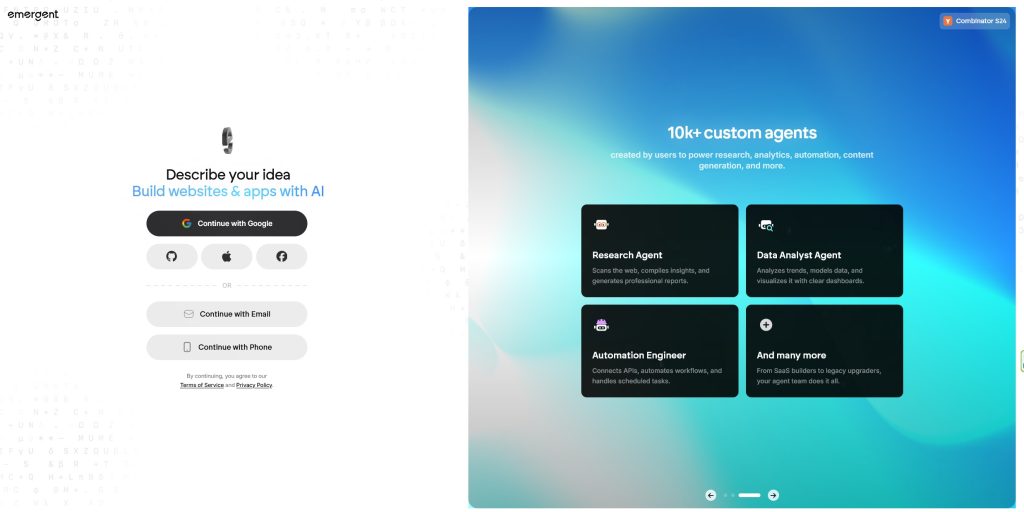
Building software traditionally requires coding knowledge, development tools, hosting, databases and often an entire development team. Emergent takes a different approach: describe what you want to build in natural language and its AI-powered platform can turn the idea into a working web or mobile application.
Instead of starting with a blank code editor, you can start with a description of your product, its features and the experience you want users to have. Emergent is designed to handle much of the technical work involved in creating full-stack applications, including interface design, backend functionality, databases, integrations, testing and deployment.
Ready to turn your idea into an application?Try Emergent
What Is Emergent?
Emergent is an AI-powered application development platform built around natural-language interaction. Instead of manually writing every component of an application, you describe what you want and AI agents help design, build, test and deploy the software.
The platform is designed for both people with programming experience and users who do not normally work with code. According to Emergent’s documentation, the platform supports full-stack application development and can take a project from an initial prompt through testing and deployment.
This makes the platform particularly interesting for entrepreneurs, product managers, marketers, designers, freelancers, small businesses and developers who want to move from an idea to a working prototype or product more quickly.
Ready to turn your idea into an application?
Try EmergentBuild Apps by Describing What You Want
The central concept behind Emergent is simple: describe the application instead of starting by writing code manually.
You can explain the type of application you want, the pages it should contain, the features users need and how different parts of the system should work. The platform then uses AI to generate the application structure and functionality.
For example, you could describe a booking system with user accounts, appointment management, an administrator dashboard and payment functionality. You can then continue refining the project through additional prompts.
This conversational approach can make software development more accessible while also giving experienced users a faster way to prototype ideas.
What Can You Build With Emergent?
The platform supports a broad range of software projects. Emergent’s current product pages highlight websites, web applications, mobile applications, dashboards, SaaS products, CRM systems, AI agents and other business applications.
Websites
Emergent can generate websites from natural-language descriptions. You can specify the pages, sections, layout, functionality and user experience you want rather than starting with a traditional template.
This can be useful for landing pages, business websites, product websites, directories and specialized online services.
Web Applications
More complex web applications can include forms, dashboards, tables, filters, user accounts, databases and custom workflows.
The platform is designed to generate both the interface and the underlying application logic, allowing you to build something more sophisticated than a simple static website.
Mobile Applications
Emergent also supports mobile application development. Its AI app builder is designed to generate application interfaces, functionality, data handling and integrations based on prompts.
Dashboards
Dashboards are another practical use case. You can provide data or describe the information you want to display and build interfaces containing charts, tables, filters and other components.
SaaS Applications
For entrepreneurs building software products, Emergent can be used to create SaaS applications with features such as user accounts, billing and backend functionality.
Internal Business Tools
Companies can also use the platform to create internal tools such as project management systems, content calendars, approval workflows, client portals and custom business applications.
Build applications with AI and natural-language prompts.
Explore EmergentFull-Stack Development With AI
One of the most important aspects of Emergent is that it is not limited to generating visual layouts.
The platform is designed to work across different layers of an application. That includes the user interface, backend logic, data structures and integrations.
This full-stack approach means that a project can evolve beyond a visual prototype into a more functional application.
Frontend
You can describe the screens, navigation, components and user flows you want. Emergent can then generate responsive interfaces based on those requirements.
Backend
Applications often require functionality that users never see directly. Authentication, business logic, data processing and APIs are examples of backend functionality that can be incorporated into an application.
Emergent is designed to generate these underlying components alongside the user interface.
Databases
Many applications need structured data. A CRM needs customer records, a booking system needs appointments and an e-commerce application needs products and orders.
Emergent can generate database structures and relationships as part of the application-building process.
AI-Powered Website Builder
For users who mainly want to create websites, Emergent provides an AI website-building workflow that starts with a description rather than a traditional template.
You can explain the type of website you need and describe its pages, features, layout and functionality. The platform can then generate the website structure and continue refining it as you provide additional instructions.
This approach can be useful when you have a clear idea but don’t want to spend hours configuring themes, plugins or visual builders.
Create websites and full-stack web applications with AI.
Build with EmergentBuild Mobile Apps With Prompts
Creating a mobile application traditionally requires knowledge of mobile development frameworks, development environments and deployment processes.
Emergent aims to simplify this process by allowing users to describe their mobile application and have AI generate the required structure and functionality.
You can define screens, user flows, features and integrations through prompts and then refine the result as the project develops.
This can be useful for prototypes, business applications, community apps, customer portals and other mobile-first projects.
AI SaaS Builder
Launching a SaaS product involves considerably more than creating a homepage. A functional SaaS application needs user accounts, data storage, business logic, billing and other infrastructure.
Emergent’s SaaS builder is designed to address these requirements through a prompt-driven workflow. The platform highlights functionality such as user accounts, billing and backend systems as part of the development process.
This makes the platform particularly relevant to entrepreneurs who want to test a software business idea without first assembling a large development team.
Build Custom Business Tools
Not every application needs to become a public SaaS product. Businesses often need small, specialized tools that fit their own workflows.
Examples include:
- Customer management systems
- Appointment scheduling tools
- Internal dashboards
- Project management systems
- Content calendars
- Client portals
- Inventory tools
- Reporting dashboards
- Approval workflows
- Custom databases
Instead of adapting an existing SaaS product to your workflow, an AI application builder can be used to create a tool around the way your organization actually works.
Build AI Agents
Emergent also offers an AI agent builder. The platform allows users to describe an agent and have AI create its structure and functionality through prompts.
This can be useful for creating specialized assistants designed around particular business processes, customer interactions or internal workflows.
One advantage of a prompt-driven approach is that changes can be requested conversationally rather than requiring users to manually rebuild an entire workflow.
Explore AI-powered agents and custom workflows.
Build an AI AgentConnect APIs and External Services
Modern applications rarely operate in isolation. They often need payment systems, analytics, CRMs, databases, communication services and other external APIs.
Emergent supports integrations with external services. Its documentation specifically highlights integrations including GitHub, Stripe, Supabase and external APIs.
The platform’s web application builder also describes integrations with payment gateways and other external services through APIs.
This means an application can be designed around a broader technology stack instead of existing as an isolated AI-generated prototype.
GitHub Integration
Developers who want more control over their projects can use GitHub integration. Emergent’s documentation lists GitHub integration as one of the platform’s capabilities.
This is particularly useful when a project needs version control or when developers want to continue working with the generated application outside the initial AI development workflow.
Testing and Iteration
Building an application is rarely a one-prompt process. Even when the initial result is useful, you will normally want to change the layout, add features, adjust workflows or correct unexpected behavior.
Emergent is designed around this iterative process. You can continue communicating with the AI and request changes instead of starting the project again.
Emergent’s documentation also includes testing, debugging and troubleshooting resources as part of its development workflow.
From Idea to Working Product
The biggest attraction of an AI development platform is the ability to shorten the distance between an idea and a working prototype.
A traditional project might begin with requirements, wireframes, development environments, framework selection, frontend development, backend development, database configuration and deployment.
With a prompt-driven platform, the initial process can begin with a simple description:
“Build a responsive customer portal where users can create accounts, view their orders, submit support requests and receive updates.”
From there, you can progressively refine the application by adding specific requirements.
The quality of the result still depends heavily on how clearly you communicate the desired functionality. Emergent itself recommends thinking about the problem, target users and essential features before writing the initial prompt.
Who Is Emergent For?
Entrepreneurs
Founders can use Emergent to turn product concepts into prototypes and working software without necessarily hiring a development team at the earliest stage.
Small Businesses
Small businesses can create specialized internal tools or customer-facing applications tailored to their specific workflows.
Marketers
Marketing teams can build campaign tools, landing pages, dashboards and other specialized applications without waiting for a traditional development cycle.
Designers
Designers can turn concepts and interface ideas into functional applications rather than stopping at static mockups.
Developers
Experienced developers can use AI to accelerate prototyping, repetitive development tasks and experimentation while retaining control over the generated code and project structure.
Non-Technical Users
People without programming experience can use natural-language prompts to describe applications instead of learning a programming language before they can start experimenting.
Start with an idea instead of a blank code editor.
Start with EmergentEmergent for E-Commerce Projects
AI application builders can also be useful for e-commerce-related projects.
Instead of creating a conventional online store only, you can build supporting applications such as product dashboards, customer portals, quotation systems, catalog tools or specialized shopping experiences.
Emergent’s catalog application examples show how product data, buyer workflows, quotes, CRM systems and payment infrastructure can be connected through APIs.
Emergent for Dashboards and Data
Businesses often have information stored in spreadsheets or other systems but lack a convenient interface for viewing and managing it.
Emergent can turn datasets into interactive dashboards with elements such as tables, filters and charts.
This makes it potentially useful for sales dashboards, inventory management, analytics, project tracking and internal reporting.
Security and Application Infrastructure
Applications handling user information require more than a visual interface. Authentication, access controls and data protection are important parts of the underlying application architecture.
Emergent’s web application materials describe features including authentication, role-based access controls and encryption.
As with any AI-generated software, developers and businesses should still review the application’s implementation, permissions, integrations and security requirements before using it for sensitive or production workloads.
What Makes the Prompt-Based Approach Different?
Traditional no-code platforms generally require users to work through visual editors, menus, templates and configuration panels.
Emergent’s approach centers on natural-language instructions instead.
| Approach | Typical workflow |
|---|---|
| Traditional development | Write and maintain code manually |
| No-code builders | Configure visual components and workflows |
| Emergent | Describe the desired result and refine it through prompts |
This does not eliminate the need for testing or technical review. Instead, it changes the way users interact with the development process.
How to Get Better Results From AI App Building
The quality of an AI-generated application depends significantly on the quality of the instructions.
Start With the Goal
Explain what problem the application should solve before describing individual buttons or colors.
Define the Users
Specify who will use the application. A customer portal, employee dashboard and public website have very different requirements.
List the Core Features
Start with the essential features rather than attempting to describe every possible function at once.
Define User Flows
Explain what should happen when a user signs up, submits a form, makes a purchase or completes another important action.
Iterate
Once the first version exists, test it and provide specific feedback. AI development works particularly well when the project is refined through several focused iterations.
Start experimenting with AI-powered development.Start Building
Emergent Pricing
Emergent currently offers a free option with monthly credits, while paid plans provide additional credits and capabilities. The official site currently lists a Free plan with 10 monthly credits and paid options for users who need more capacity.
Because AI development costs can depend on the complexity and number of tasks involved, it is worth checking the current pricing and credit system before starting a larger project.
Is Emergent Suitable for Beginners?
One of the platform’s main goals is to reduce the technical barrier to software development. Emergent explicitly positions the platform for users ranging from complete beginners to experienced developers.
For a beginner, the biggest advantage is being able to describe an idea in ordinary language instead of learning a programming language first.
However, beginners should still understand that building a serious application involves testing, security, data management and ongoing maintenance. AI can automate many development tasks, but it does not remove the need to evaluate whether the resulting application actually works as intended.
Emergent for Developers
Developers can approach the platform differently. Instead of replacing traditional development entirely, AI can be used as a productivity layer for prototyping, generating components, testing ideas and accelerating repetitive work.
GitHub integration and generated code can also make it easier to move from AI-assisted creation toward a more conventional development workflow when necessary.
Emergent vs Traditional App Development
The biggest difference is where the development process begins.
Traditional development begins with technical implementation. You select frameworks, configure environments and begin writing code.
With Emergent, the starting point is the product idea. You describe the application and allow AI to handle much of the technical implementation.
This can significantly change the early stages of software development, particularly for prototypes and projects where speed of experimentation is important.
Emergent vs Traditional No-Code Platforms
Traditional no-code tools generally use visual interfaces where users assemble applications using predefined components.
Emergent focuses on conversational development. Instead of manually assembling every component, you can describe the result and ask the AI to make changes.
This approach can be especially useful for projects that do not fit neatly into a predefined template.
What Types of Projects Make Sense?
Emergent can be particularly interesting for:
- Startup prototypes
- MVP development
- Internal business software
- Customer portals
- Dashboards
- SaaS products
- Booking systems
- CRM tools
- AI-powered applications
- Mobile applications
- Business websites
- Custom productivity tools
The platform can also be used to experiment with ideas that would otherwise require a significant initial investment in development.
Have an idea for an app or SaaS product?Explore Emergent
Frequently Asked Questions
What is Emergent used for?
Emergent is used to build websites, web applications, mobile apps, dashboards, SaaS products, business tools and AI-powered applications using natural-language prompts.
Do I need programming experience?
No. The platform is designed for both beginners and experienced developers. Users can describe what they want to build in natural language rather than writing every part of the application manually.
Can I build a website with Emergent?
Yes. Emergent provides an AI website builder that can generate websites from natural-language descriptions.
Can I create a mobile app?
Yes. Emergent supports mobile application development and provides an AI app builder designed around prompts.
Can Emergent build SaaS applications?
Yes. Its SaaS builder is designed for creating software products with features such as user accounts, billing and backend functionality.
Can I connect external APIs?
Yes. Emergent supports integrations with external APIs and services, including examples such as Stripe, GitHub and Supabase.
Can I use GitHub with Emergent?
Yes. GitHub integration is listed among the platform’s features and can be useful for version control and continued development.
Can Emergent create an AI agent?
Yes. The platform includes an AI agent builder that allows users to create specialized AI agents using natural-language instructions.
Is there a free plan?
Yes. Emergent currently offers a Free plan with monthly credits. Paid plans provide additional credits and capabilities.
Who should consider using Emergent?
Entrepreneurs, developers, designers, marketers, product managers, small businesses and people with software ideas can all potentially benefit from a prompt-driven application development platform.
Start Building With AI
Emergent represents a shift from traditional software development toward conversational, AI-assisted application creation. Instead of beginning with code, users can begin with an idea and progressively turn that idea into a working website, application, dashboard, SaaS product or mobile experience.
Its combination of natural-language development, full-stack functionality, integrations, testing, deployment and GitHub support makes it relevant to both non-technical creators and experienced developers.
If you have an application idea you’ve been putting off because development seems too complicated, a prompt-driven platform can provide an interesting way to experiment with it.
Turn Your Idea Into a Working App
Turn Your Idea Into a Working App
Explore Emergent and start building websites, applications and software with AI.
Start Building with Emergent