
Anker SOLIX – Portable Power Stations, Solar Generators & Home Backup
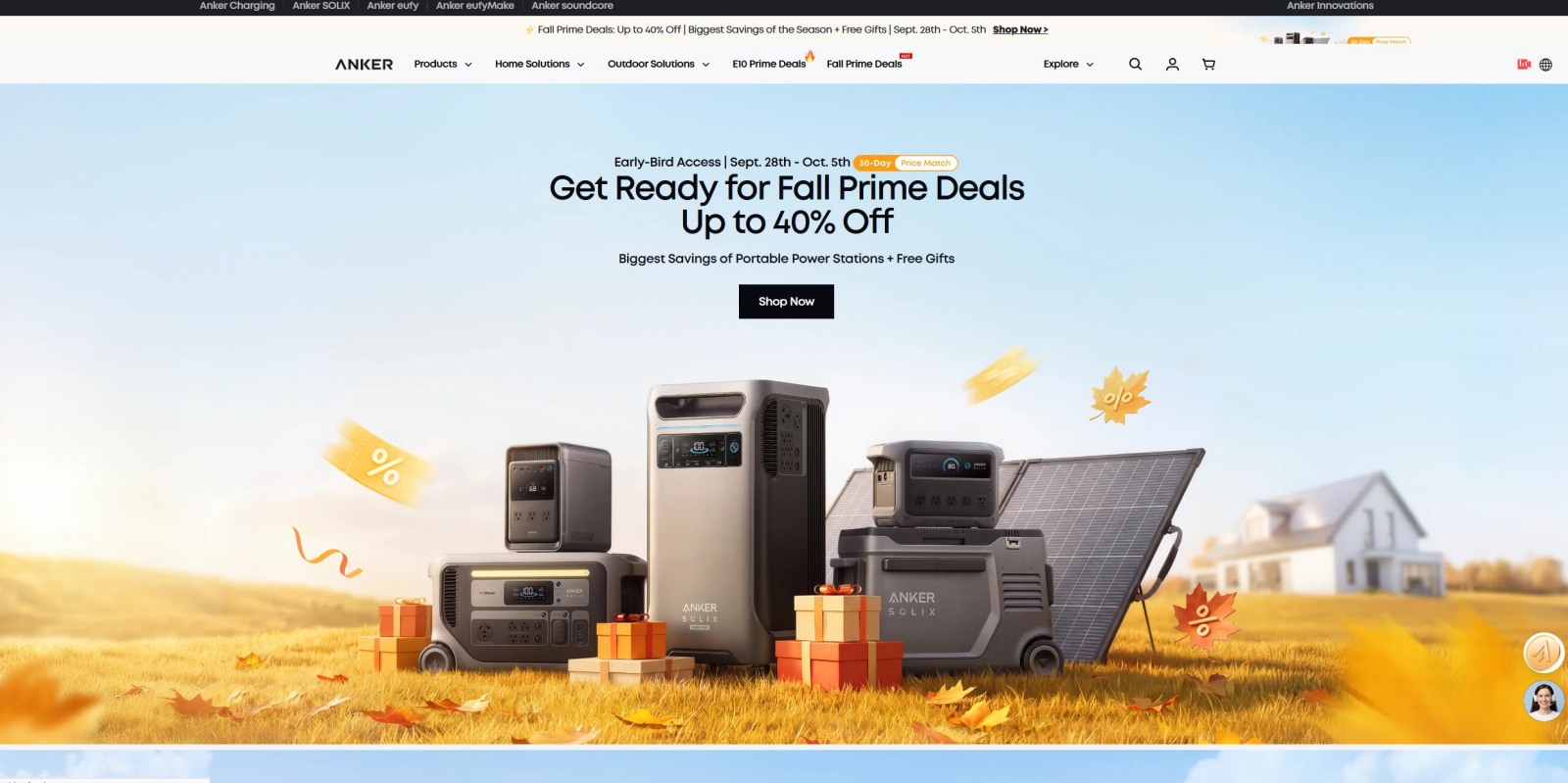
Anker SOLIX is a dedicated energy product line focused on portable power, solar charging, battery storage and backup electricity. The range is designed for a wide variety of situations, from camping and road trips to emergency preparedness, home backup and larger energy storage systems.
The product family includes portable power stations, solar generators, portable solar panels, rigid solar panels, expansion batteries and complete backup systems. This makes the ecosystem relevant to people who need occasional electricity away from the grid as well as homeowners looking for a more comprehensive backup solution.
Smaller portable Anker SOLIX power stations can provide convenient electricity for phones, laptops, lights, cameras and other electronics. Larger systems can support appliances and essential household loads, while expandable battery platforms allow users to increase available energy storage as their requirements change.
Solar charging is another important part of the ecosystem. Compatible solar panels can recharge selected power stations during outdoor trips or power outages, creating a more flexible setup than relying exclusively on wall outlets.
Anker SOLIX Portable Power Stations
Portable power stations are rechargeable battery systems designed to provide electricity away from a conventional wall outlet. They combine battery storage with multiple output options, allowing users to power electronics, appliances and other equipment depending on the model.
The range includes compact units intended for lightweight portable use as well as larger systems designed for substantially higher loads. Models such as the C300, C1000 Gen 2 and C2000 Gen 2 occupy different positions in the lineup, giving users several capacity and output levels to consider.
A portable Anker SOLIX power station can be useful for camping, RV trips, outdoor projects, photography, remote work and emergency preparedness. Unlike a conventional fuel generator, a battery-based system can operate without combustion and can be recharged from the electrical grid, compatible solar panels or other supported sources.
When choosing a unit, battery capacity is only one specification to consider. Output wattage, surge capability, available AC outlets, USB ports, DC connections, solar input and physical weight can all affect whether a particular model is suitable for your needs.
Anker SOLIX Compact Power Stations for Outdoor Use
Smaller battery stations are particularly useful when portability is more important than maximum capacity. They can provide power for phones, tablets, laptops, cameras, lights, portable refrigerators and other relatively modest loads.
Compact models are easier to transport and can be practical for weekend camping, road trips and outdoor activities. They can also serve as a backup battery at home when you need temporary power for selected electronics.
The C300 family, for example, is positioned toward portable use, while larger models provide additional capacity and output for users with more demanding requirements.
When choosing a compact unit, consider its weight alongside battery capacity. A larger battery may provide more runtime but can become significantly less convenient to carry. For hiking or short trips, portability can be more important than maximum energy storage.
C1000 Gen 2
The C1000 Gen 2 sits in the portable power category for users who need more capability than a compact travel battery can provide. It is designed around a balance between usable capacity, output power and portability.
This type of power station can be useful for camping, backup charging, outdoor work and emergency preparedness. It can support multiple devices simultaneously and can be paired with compatible solar panels for alternative recharging.
When considering a system in this class, look at the equipment you actually expect to power. A laptop, refrigerator, lighting system or cooking appliance can have very different energy requirements, so calculating expected runtime is more useful than choosing solely by battery capacity.
C2000 Gen 2 and Higher-Output Systems
Users with higher power requirements can move toward larger platforms such as the C2000 Gen 2. These systems are designed for more demanding applications where additional output and energy storage are important.
A higher-output power station can be useful for running several devices simultaneously or supporting equipment with greater power requirements. It can also provide more flexibility during longer outdoor trips or extended power interruptions.
For larger systems, portability becomes a relative term. Although these units can still be moved, they are more suited to vehicles, campsites, workshops, emergency backup and semi-permanent applications than lightweight travel.
Users should also consider whether expansion batteries or solar input are supported. These features can make a significant difference when a system is expected to provide electricity for longer periods.
Anker SOLIX Solar Generators
Solar generators combine battery storage with solar charging to create a flexible electricity system. Instead of treating the battery and solar panels as completely separate products, a solar generator kit brings them together as a coordinated power solution.
This type of system can be useful during outdoor activities, emergencies and situations where access to grid electricity is limited. Solar panels can recharge the battery during daylight, while stored energy can then be used when the sun is unavailable.
The size of the solar generator should be selected according to the loads you expect to run and how frequently you can recharge the battery. A larger battery can provide longer runtime, while higher solar input can reduce the time required to restore the stored energy.
Solar generators can also be configured for home backup. Larger systems can provide power for essential appliances and, depending on the installation and equipment, substantially more household loads.
Anker SOLIX Solar Generator Kits
A solar generator kit typically combines a battery power station with compatible solar panels and may include additional accessories. This can simplify the process of creating an off-grid or backup charging setup.
For occasional outdoor use, a smaller kit can provide enough energy for electronics and basic equipment. Larger configurations can combine high-capacity power stations with multiple solar panels and expansion batteries.
The advantage of purchasing a coordinated system is that the components are designed to work together. Nevertheless, it is still important to check solar input limits, panel compatibility and the expected charging conditions before building a system.
Anker SOLIX Portable Solar Panels
Portable solar panels are designed for users who want to recharge a battery system away from the electrical grid. They can be used for camping, road trips, RV travel, outdoor work and emergency preparedness.
The lineup includes portable panels in different power levels, allowing users to choose a configuration that matches the solar input supported by their power station.
Portability is especially important with folding panels. A panel that is easy to transport and set up can be more practical for camping and travel than a larger fixed installation.
Solar conditions also have a major effect on real-world performance. Panel orientation, weather, shading and available daylight all influence how much energy can be generated at a given time.
Anker SOLIX Rigid Solar Panels
Anker SOLIX Rigid solar panels are intended for more permanent installations than portable folding panels. They can be used as part of larger solar energy systems and are particularly relevant to home energy storage and off-grid applications.
For a home installation, panel placement and available roof or ground area become important factors. The total solar generation capacity should also be considered alongside battery storage.
A larger battery without sufficient solar input may take longer to recharge, while a large solar array paired with limited storage may not make full use of available generation. A balanced system is therefore important.
Anker SOLIX Home Backup Power
Home backup is one of the most significant areas of the SOLIX ecosystem. Larger battery systems are designed to keep selected household equipment operating when the electrical grid is unavailable.
Backup requirements vary considerably from one home to another. Some households only need power for Wi-Fi, lighting, phones and refrigeration. Others may want to support larger appliances, work equipment, pumps or additional circuits.
The appropriate system therefore depends on both battery capacity and inverter output. A battery can store a large amount of energy but still have limitations on how much power can be delivered at once.
Expandable systems provide another advantage because they can increase stored energy as backup requirements grow. This can be useful for homeowners who prefer to begin with essential loads and expand later.
Whole-Home Backup
Whole-home backup represents a different scale of energy storage from a portable battery. Systems in this category are designed to provide a more comprehensive solution for keeping household circuits powered during an outage.
The E10 platform is positioned for whole-home applications, with scalable configurations combining power modules and batteries. Depending on the configuration, systems can be expanded with additional storage and connected to home electrical infrastructure.
Whole-home systems require more planning than a portable power station. Electrical installation, transfer equipment, circuit selection, local regulations and professional installation requirements should all be considered.
For homeowners evaluating this type of system, the first step should be identifying which circuits and appliances need backup. This helps determine the required output and storage capacity.
Anker SOLIX E10 Home Energy System
The E10 is part of the larger home energy system category and is designed around scalable battery backup. Configurations can combine power modules, batteries, power docks and other components depending on the desired installation.
This type of system is aimed at homeowners who want a more integrated energy backup solution rather than a portable battery that is manually moved from one location to another.
Scalability is particularly useful because energy requirements can change over time. A homeowner may initially want backup for essential circuits and later decide to increase storage or add solar generation.
Large systems should always be planned around actual household consumption rather than simply choosing the largest available battery. Understanding peak loads and daily energy usage provides a better basis for selecting equipment.
Anker SOLIX Battery Energy Storage
Battery energy storage provides a way to store electricity for later use. In a solar-powered configuration, energy generated during the day can be stored and used when solar production falls.
Storage can also provide backup during grid outages. Instead of depending entirely on immediate solar generation, a sufficiently sized battery allows stored energy to be used when needed.
The ecosystem includes expandable battery configurations that can increase total available storage. This is particularly relevant for larger home backup systems where several hours of operation may not be enough.
When comparing energy storage products, consider usable capacity, maximum output, battery chemistry, cycle life, charging options, expansion capability and warranty coverage.
Anker SOLIX Expansion Batteries
Expansion batteries allow compatible systems to increase their stored energy without replacing the main power station. This modular approach can make it easier to scale a system according to changing requirements.
For example, a portable power station may be sufficient for short outages but additional storage can become useful during longer interruptions. Similarly, a home backup system may need more capacity when additional appliances are added to the backup plan.
Expansion batteries are particularly useful when the power station is already capable of supporting the required output and only additional runtime is needed.
Before purchasing an expansion battery, check compatibility with the exact power station model and configuration. Battery expansion is not universal across all products.
Anker SOLIX Off-Grid Power
Off-grid applications require a combination of energy generation, storage and power management. Solar panels can provide energy during daylight, while batteries store electricity for use later.
This approach can be useful for remote cabins, workshops, RVs, campsites and other locations without reliable grid access.
Off-grid systems should be sized according to actual energy consumption. Lighting, refrigeration, communications equipment, tools and heating or cooling can have dramatically different energy requirements.
Solar availability is also important. A system that works well during long summer days may require substantially more battery storage during periods of limited sunlight.
Anker SOLIX Camping and Outdoor Power
Portable energy is especially useful for outdoor activities. A power station can provide electricity for phones, cameras, laptops, lights, coolers and other equipment without requiring access to a campsite electrical hookup.
For camping, portability and noise are important considerations. Battery systems can operate without the combustion noise and exhaust associated with conventional fuel generators.
Solar panels can extend the useful time away from the grid by providing a way to recharge the battery during daylight. A properly sized panel and power station can therefore support longer trips without relying on a conventional electrical outlet.
For RV users, the requirements may be higher because refrigerators, cooking equipment, entertainment systems and other appliances can draw significant energy. Larger power stations and additional batteries may be more appropriate for these applications.
Anker SOLIX RV and Road Trip Power
Road trips and RV travel create many of the same requirements as camping but often involve more equipment. A larger battery station can provide electricity for cooking, cooling, entertainment and work equipment when connected to compatible loads.
Vehicle charging can also be useful for maintaining battery capacity during travel. Depending on the model and available accessories, portable systems can be recharged from vehicle power as well as wall outlets and solar panels.
For extended travel, combining vehicle charging with solar generation can provide multiple ways to replenish stored energy. This flexibility is useful when weather conditions or access to electrical hookups are unpredictable.
Emergency Preparedness
Power outages can affect lighting, communications, refrigeration, internet connectivity and other household functions. A battery backup system can provide temporary electricity while grid service is unavailable.
A sensible emergency setup starts by identifying essential loads. Phones and communication equipment are obvious priorities, but refrigeration, medical equipment, internet equipment, lighting and heating or cooling may also be important depending on the household.
Once the essential loads are identified, estimate their combined power requirements and expected runtime. This makes it easier to determine whether a compact portable station is sufficient or whether a larger expandable backup system is required.
Solar charging can add another layer of resilience by allowing the battery to be replenished when grid power remains unavailable for an extended period.
LFP Battery Technology
Many modern energy storage systems use lithium iron phosphate, commonly known as LiFePO4 or LFP, battery chemistry. This chemistry is widely used in portable power and stationary energy storage because of its combination of cycle life and stability.
Battery chemistry is only one part of overall product reliability. Thermal management, electronic components, charging controls and the physical construction of the system also affect long-term performance.
For anyone comparing portable power stations, it is therefore useful to consider the complete battery system rather than focusing only on capacity. Cycle life, warranty, operating temperature and charging options can all be relevant.
Anker SOLIX Solar Charging
Solar charging allows compatible power stations to convert energy from sunlight into stored battery power. The practical charging speed depends on panel capacity, solar conditions and the maximum solar input supported by the power station.
Cloud cover, shade, panel orientation and time of day can all reduce solar generation. For this reason, the rated wattage of a panel should not be interpreted as a guaranteed continuous output.
Larger systems can support higher solar input and multiple panels, making them better suited to home backup and off-grid applications. Smaller portable systems can use compact folding panels that are easier to transport.
Smart Energy Management
Modern energy storage systems increasingly include software that helps users monitor their equipment. App-based controls can provide information such as battery level, charging status, solar input and energy consumption.
This type of monitoring can make it easier to understand how much energy remains and how quickly a solar array is replenishing the battery.
For home backup systems, monitoring can also help users understand which loads are consuming the most energy. This information can be useful when deciding which appliances should remain powered during an outage.
How to Choose the Right Power Station
The correct power station depends on three main factors: how much power your equipment needs, how long you need it to run and how you intend to recharge the battery.
Start by listing the devices you expect to use. A phone charger may require relatively little power, while a refrigerator, microwave, power tool or other appliance can require considerably more.
Next, estimate how long each device needs to operate. A high-power appliance used for a few minutes may consume less total energy than a lower-power device operating continuously for many hours.
Finally, consider recharge options. If the system will mainly be used at home, grid charging may be sufficient. For camping or extended outages, solar input can become much more important.
| Use Case | Recommended Category | Key Factors |
|---|---|---|
| Weekend Camping | Compact Power Station | Weight, capacity and portability |
| RV Travel | Large Portable Power Station | Output, capacity and recharge options |
| Emergency Backup | Solar Generator | Battery capacity and solar input |
| Home Essentials | Home Backup System | Output, circuits and runtime |
| Whole-Home Backup | Whole-Home Energy System | Scalability, installation and storage |
| Remote Location | Off-Grid Kit | Solar generation and battery storage |
Battery Capacity vs. Output Power
Battery capacity and output power describe different characteristics of an energy storage system. Capacity determines how much energy can be stored, while output determines how much power the system can deliver at a given moment.
This distinction is important when choosing a system. A large battery does not automatically mean that every high-power appliance can be operated. The inverter and output specifications must also support the appliance.
For example, a household may need substantial stored energy for a refrigerator and lighting over many hours but relatively high instantaneous output when a motor starts. Both requirements need to be considered.
For larger home systems, professional planning can help determine the appropriate combination of battery storage, inverter output and backed-up circuits.
Solar Panels and Battery Storage Together
Solar panels and batteries serve complementary functions. Panels generate electricity, while batteries store it for later use.
During sunny periods, solar generation can power active loads while excess energy is stored. Later, when sunlight decreases, stored energy can be used to maintain power.
The balance between generation and storage depends on the application. A weekend camper may only need a compact panel, while a home energy system can use a substantially larger solar array.
For backup applications, battery storage is particularly valuable because the system can provide power immediately even when the sun is not available.
Energy Solutions for Home Offices
Power interruptions can be particularly inconvenient for people who work from home. A battery system can keep a laptop, monitor, router and other essential equipment running during a short outage.
For a home office, power requirements are usually easier to estimate than whole-house consumption. Listing the wattage of the computer, displays, networking equipment and other essential devices provides a practical starting point.
A portable power station can be enough for temporary backup. Users who require longer runtime or want automatic home integration may consider a larger home backup system.
Energy Solutions for Workshops
Workshops can benefit from portable electricity when equipment needs to be used away from a conventional outlet. Depending on the power station, applications can include lighting, chargers, electronics and selected tools.
High-power tools require careful consideration because their starting and operating loads can be significantly higher than those of consumer electronics.
Always compare the actual power requirements of tools with the output specifications of the battery system before connecting them.
Energy Storage for Everyday Resilience
Battery storage does not have to be reserved for emergencies. A properly configured system can provide useful flexibility during everyday activities and outdoor use.
Portable power stations can be used for remote work, garden projects, photography, travel and recreational activities. Larger home systems can provide backup capability while also integrating with solar generation.
This flexibility is one of the main reasons energy storage has become increasingly relevant to modern households. The same equipment can support everyday activities and provide an additional layer of preparedness when grid power is unavailable.
What to Check Before Buying
Before selecting an energy storage product, check battery capacity, continuous output, surge capability, charging speed, solar input, available ports and expansion options.
For portable use, weight and dimensions are especially important. A system that is technically capable of powering your equipment may still be impractical if it is too heavy to transport.
For home backup, installation requirements become much more important. Larger systems may require transfer equipment, dedicated circuits and professional electrical work.
For solar installations, also consider available space, sunlight exposure, panel configuration and local installation requirements.
Frequently Asked Questions
What is Anker SOLIX?
Anker SOLIX is an energy product line focused on portable power stations, solar generators, solar panels, battery storage and home backup power solutions.
What is a portable power station?
A portable Anker SOLIX power station is a rechargeable battery system with outputs such as AC outlets, USB ports and DC connections. It can provide electricity when a conventional wall outlet is unavailable.
Can these power stations be charged with solar panels?
Selected models support compatible solar charging. The maximum solar input depends on the specific power station and panel configuration.
Can a solar generator power a home?
Some larger systems are designed for home backup and can support selected household circuits or, with an appropriate whole-home configuration and installation, much larger portions of a home.
What is the difference between a power station and a solar generator?
A power station is the battery and power conversion system, while a solar generator setup generally combines a power station with solar panels and related equipment for solar-based recharging.
What is the E10 system?
E10 is a scalable home energy system designed for whole-home backup applications. Configurations can combine power modules, batteries, power docks and solar equipment.
Are these products suitable for camping?
Yes. Portable models are designed for outdoor applications including camping, road trips, RV travel and other situations where access to grid electricity is limited.
Can I expand the battery capacity?
Selected systems support compatible expansion batteries. Always check the specifications of the exact power station before purchasing additional storage.
Do I need solar panels?
Not necessarily. Compatible power stations can typically be charged from other supported sources, such as the electrical grid. Solar panels become especially useful for outdoor use, off-grid applications and extended outages.
Are LFP batteries used in the power stations?
Selected models use LiFePO4 or LFP battery technology. Check the specifications of the individual product because battery characteristics can vary between models.
Can these systems power refrigerators?
Some higher-output models can support refrigerators and other household appliances, provided that their continuous and startup power requirements fall within the capabilities of the selected system.
Can a power station run a laptop?
Yes. Portable power stations can provide power for laptops through compatible AC or USB-C outputs. Runtime depends on the laptop’s power consumption and the capacity of the battery system.
Are larger systems suitable for whole-home backup?
Selected larger systems are designed specifically for home and whole-home backup applications. These installations require careful planning around household loads, electrical circuits and installation requirements.
Explore Anker SOLIX Energy Solutions
The SOLIX ecosystem covers a wide range of energy requirements, from compact portable power to scalable home backup. Portable power stations provide electricity for travel, camping and outdoor projects, while solar generators combine battery storage with renewable charging.
For homeowners, larger backup platforms can provide power during outages and can be expanded as energy requirements change. Solar panels can add another charging option, while whole-home systems provide a more integrated approach to household energy resilience.
The most important step is to start with your actual requirements. Consider what you need to power, how long it needs to operate, how portable the system needs to be and how you plan to recharge it. Those factors will help determine whether a compact power station, a solar generator, an expandable battery system or a whole-home solution makes the most sense.